
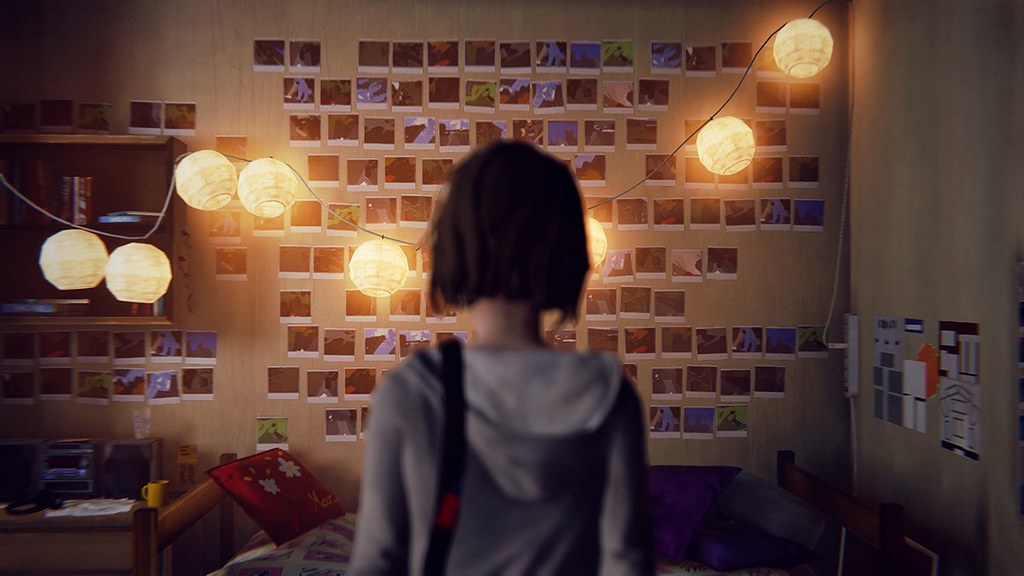
I spent a few minutes trying to think of some sort of addition to the title of this post, but nothing came to mind, as nothing felt like it would suffice. It’s currently around 11:00 pm here, and I’ve just wrapped up my complete playthrough of Dontnod’s story driven, choice heavy, ‘Life is Strange.’ Around half way through the final episode I had this thought to my self; ‘There is no way that this episode is going to end up as a satisfying conclusion to the story. There’s just way too much in the air at the moment.’ I was wrong. Without wishing to spoil anything, I’ll just say that the ending was something that really made me ponder whether all (or any) of the decisions I’d made to lead me up to that point had been right. This post is going to be really hard to write because it’s really important for me not to spoil this game for anyone that hasn’t played it. And if there is any fear that reading this may ruin anything about the excellent story and characters, stop reading now. What a good way for me to promote my blog.
For those of you who have either played it or are trusting enough to have faith in my ability to not ruin the story, thanks. When I watched the credits roll on episode 5, I just sat there. I held my controller in my hands and just thought about what might have been if I’d chosen a different path throughout the story. The game’s incredible emotional sections are driven by intense and meaningful choices, all of which are excellently lent a sense weight simply by the fact that you can reverse your timeline to the point before you made them. The excellent idea to give Max the ability to change choices based on the immediate fallout makes each decision hold real power. Sure, you know what the result of the event is going to be now and if you don’t like what you just said, you can make everybody forget. The reason why it works so incredibly well is because you have no knowledge over what effects it’s going to have in the future. A scene in which you see Max receive instant gratification for her actions may later lead result in a worse outcome overall. It all flows surprisingly well together to form a cohesive and thoughtful plot where you’re accosted on every side by the repercussions of something you may have done several episodes ago.
On the technical front, I have to admit that the game sometimes falters, most noticeably in the lip syncing. Having a character deliver dialogue half a second out of time with their mouths is jarring, as is a scene in the final episode where max apparently telepathically had a full conversation with someone, because she didn’t move her mouth at all. That’s really the only complaint that you can leverage at this game, and whilst in fairness it will be a damming quality for some, I was happy to look past it and enjoy the quality rest of the experience. Speaking of quality, the cinematography is generally excellent throughout the 5 episodes. The game does contain just a few to many focus shifting shots for my liking, but it’s so rare to see a game with cinematic prowess on the level of some of the best work Hollywood has ever produced. The shot composition and framing frequently reminded me of Spike Jonze’s ‘Her,’ with it’s great capturing of the lighting but the restraint to not overdo them. The final scenes of episode one really demonstrate this, presenting a few truly breathtaking shots without having too many.
Unfortunately, the further and further I get into this post, the more I realise that every line I write is ruining the ability for others to experience the subtleties first-hand, unspoiled. Seriously, play this game. I can’t stress enough how much it deserves to be played. In the recent sea of adventure games (most of which are admittedly quite good), Life is Strange still stands out as a one of a kind experience, taking the notion of choice driven game play and turning it on it’s head by introducing a clever time travel mechanic. That’s all I can say. Play it. Now. Please?

 Y, Though?