
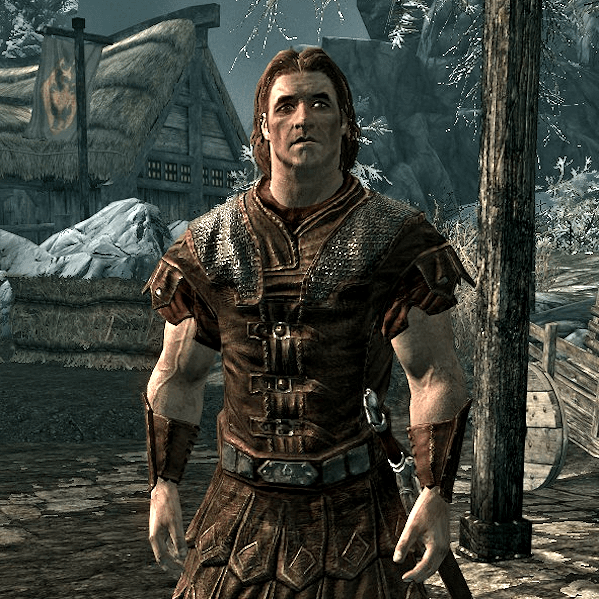
Ahh, 4am. Or likely something like 7am when this is published. How thou doth test me. To be fair, this is a topic, or at least an idea, that’s been dangling in the back of my mind for some time now. A recent plan was to perhaps write a piece about the road to ≈ 100% in Skyrim, following the trials and tribulations to be found in reaching an arbitrary level that I deemed suitable, completing as many quests as possible, and perhaps settling down with a significant other who spouts the same three phrases at me every morning to earn my affection. The key word of the previous sentence was arbitrary, but we’ll get to that later.
Before the idea of writing on Skyrim, I had foolishly thought to do the same with Oblivion, the Elder Scrolls endeering, but perhaps somewhat misguided, middle child (middle in the sense that no-one really counts Arena and Daggerfall as being in the same vein as the three recent entries (Note to self, don’t completely forget to update this when the TES 6 comes out). I say my idea to take a look at Oblivion from no particular angle other than my own opinion was foolish because it’s densely packed, slow paced (at least when you play it as I do), and often times extremely frustrating. Even a cursory look at the many critiques of the game will shed ample light on the games myriad problems. Combat is almost exhaustingly poorly executed, with the games magic system suffering the most from slow animations and underwhelming feedback. Oblivion was, after all, the game that popularised the ‘sneaky archer,’ a character build designed almost entirely around being able to either avoid or expediate the act of engaging enemies. The RPG elements similarly suffered from a lack of polish. A common criticism of the Elder Scrolls, and perhaps Oblivion in particular, is its failure to mask its illusion of choice. Not only are you unable to act in ways you might deem fit the majority of the time, the game sometimes has you perform actions and reach conclusions in the most counter intuitive ways possible. If there’s a simple solution to a problem, chances are that the Hero of Kvatch won’t think of it. The player might, but the avatar doesn’t. Of course, these problems are small fry when compared to Oblivion‘s most infamous feature: the faces. Oh god, the faces. Now, I’m not saying that the reason I was hospitalised for the entire month of April and was unable to engage in any sort of social interaction without having a nervous breakdown is because the faces in Oblivion deeply psychologically damaged me at a fundamental level… but there’s no smoke without fire. Everyone looks a bit like if Frankenstein’s monster had been made not only from a mish-mash of body parts but also from some melted wax, and the way the camera can sometimes rotate 180º without warning a quick zoom in on said afront to god is literally terrifying. You don’t know true fear until one of Cyrodil’s uniform faced guards sneaks up behind you and screams at you whilst you’re busy picking up cuttlery.
Sorry, that Oblivion tangent went on longer than expected, but I’ll be damned if I’m going to edit it out. The point, that I so elequently failed to reach, is that trying to do everything in that game (especially when you don’t fast travel, which I also failed to mention), you rapidly realise how tortured existance is. I’m only mostly joking, but after many hours of seeing what it would be like if the uncanny valley had a stroke, I decided to move onto greener pastures. As said earlier, TES V was my next attempt. A more wholesome experience, Skyrim was my way of alleviating boredom whilst in hospital. Being the proud owner of Nintendo’s newest money vacuum, I did something with which I thought I was finished: purchased another copy of Skyrim. By my calculation, this is my fourth (or perhaps fifth if the free steam upgrade is included) copy of the game that I have purchased with my own hard earned money. Well I say hard earned, but to be honest, once the screaming stops, woodchipping corpses is quite an easy job. (When this is read back in court, I’d like it on record that I was joking. It’s actually quite a hard job). Never-the-less, I found myself in posession of yet another version of Todd Howard’s baby, and was once again dragged into the land of dragons, draugr and voice actors having conversations with themselves. Skyrim is by no means a perfect game, but it’s nice to see some genuine steps in the right direction from Bethesda, taking what worked from Oblivion, like the introduction of more active combat rather than Morrowind‘s cursed dice rolls and the fully voiced cast, whilst removing or altering what didn’t. Gone is the conversation pie, the conversations that take place in their own pocket of time, and the enemy health bars whose length make me feel insecure in my manhood.
Despite these improvements, I didn’t complete the mission I’d set for myself. Sure, the two week reign of Alduin had been brought to an anti-climactic close, the College of Winterhold had succeeded in whatever it was they’d been trying to do, the world’s least intimidating vampire had been slain, and I’d built my little home on a hill, but I still hadn’t reached the goal I’d set for myself, as nebulous and unspecific as it had been. However, I rested easy with the knowledge that I had once before, in a simpler time, achieved what could be considered the completion of Skyrim. The copy of the game I own on PS4 os officially platinumed (base game only, I’m not a psychopath). Every major faction quest was completed, deadric artifacts had been gathered despite their habit of not registering as being collected, and my Orc warrior was a proud level 54, decked out in heavy dragon bone armor. Perhaps once was enough. Perhaps I shall return to Skyrim on Switch one day and finish what I started. Perhaps Firefly will return.
Post-Skyrim saw an unlikely candidate absorb a lot of my time. Assassin’s Creed III, the much maligned end of what we should probably start calling phase one of the series. Whilst a comercial and somewhat critical success at launch, AC3 has somewhat of a reputation as this weird, misguided attempt to elevate the series. The less city-based and more wilderness-centric gameplay, the strange crafting system, and the naval combat were but the first steps towards the Assassin’s Creed we know today, and as such are a point of contention for many. The series is an almost entirely different beast today as it was even when AC3 launched, but you could be forgiven for thinking that the divergence started here. Again, though, that’s a serious point of contention. For what it’s worth, I have somewhat of a soft spot for the story of Connor and his journey through the American revolution. I enjoy the more overt libertarian tones of the story but also appreciate the recognition that the Assassins and Templars might have more similarities than either would like to admit. I powered through the main storyline trying to reach full synchronization where I could, telling myself I’d go back later where I couldn’t. I did all the homestead missions. I genuinely marveled at the visual improvements brought on by the remastered graphics on PS4. All this, and I still wasn’t done. Don’t get me wrong, I’ve stopped playing for the forseable future, but I didn’t achieve the goal of getting a platinum trophy or even simply reaching 100% synchronization (which I’m casually saying here like it’s not a huge endevour or anything). Still, of the recent games I’ve played, this is the closest I’ve been to being satisfied that I’ve done everything I should do. I haven’t reached that full synchronization, but I’ve certainly had my fill for now. It’s less a case of having content unfinished, rather that I haven’t perfected what has been done.
My latest, and currently ongoing, adventure is in the sun-kissed hills and densely packed cities of ancient Greece, in Assassin’s Creed Odyssey. For context, I should say that I quite like the Assassin’s Creed franchise. That may seem obvious, but given how much shit I talk about it sometimes (though I’m yet to fully unload that on the blog yet), you’d be forgiven for thinking I hate the series. I truly don’t. I actually love a lot of it. I have fond memories of AC2, Brotherhood and Revelations, I admire the ambition of AC3 and Unity, and, whilst I still see it as the first true sign of the series perhaps loosing its way, it would be remiss of me not to admit how enjoyable Assassin’s Creed 4 can be. Origins was where I truly began to fall out with the series. Whilst I’ve only put a few hours into Syndicate, it still feels like its heart was in the right place. Origins however, was, in my admitedly jaded eyes, a cynical and creatively lazy attempt to cash in on the success of the Witcher 3. The huge open world with dissapointingly scarce civilisation (I’m Australian), the reduced focus on the ‘Assassin’ part of Assassin’s Creed, and the greater emphasis on a skill tree and light RPG mechanics all looked to me like the kind of thing a studio might do when it decides it wants more mainstream success. It’s hard to argue that Origins isn’t in many ways a ‘poor man’s Witcher 3.‘ Of the perhaps 6 – 12 hours I’ve put into Origins, I remember very few. It’s all a blur of simplistic side quests, deserts, and betrayal of what I feel made the series great to begin with. When Odyssey was announced, my heart sunk. ‘This is where the series is staying,’ I thought to myself. Gone were the days when Assassin’s Creed was its own thing. Where if I wanted to parkour around a beautiful recreation of an ancient city, immersed in a story of two warring factions secretly battling in the shadows, and a precursor race that put in place the foundatons for everything we know today, all I had to do was play some AC. What had taken its place was a generic, empty, and ultimately forgettable series of games, divorced from what had driven the series into popularity to begin with. The success of Origins meant that the course of the series had been altered for good.
But surprise, I’m actually really enjoying Odyssey. It’s still almost entirely detatched from the series I once knew, but it seems more confident in its own existance now. Not to beat a point to harshly, but Origins often felt to me like it embarassed, or at the very least disinterested in the games that had come before. Odyssey feels more like an ernest expansion of the series. It’s not trying to replace the old games. It sees them as its ancestors. There’s a respect there, which can be seen in the return of denser urban environments and a more focused story that feels a lot more like the older entries. Assassins and Templars may not be fully formed when the game takes place, but there’s more connection there, rather than the hand-waivy nature of Origins. I can actually appreciate this as a sequel that goes in a different direction rather than a soft-reboot that wants to take what’s popular in the industry instead of what’s a good ft for the series.
But when will I be done with Odyssey? Once the main quest is complete? Perhaps when I have a platinum trophy? Do I need to do all the side quests? These are inherent problems (for lack of a better word) with open world games. Their very nature often gives them no definable ‘end.’ With a linear game, the finish line is much more concrete. I feel a large part of the reason why it’s dificult to tell when I’m done with an open world game is because they’re designed to never really end. Countless side quests litter the genre as a means of giving players things to do other than the main story, but by their very nature, they are almost entirely unnecessary. Now, their necessity does vary from game to game in the genre, and even in the AC series itself. Whilst completely superfluous in earlier games, it’s not almost a necessity to do at least some of the side content in the game if you don’t want to be turned into paste by every enemy in the late game. Still, you have your pick of which side quest to do, and there’s a constant stream of randomly generated quests to pick up as well, ensuring that you’re never truly ‘done.’ And there lies the crux of the matter. I should clarify, I’m not trying to say this is inherently bad. Arguments could be easily made that this bevy of content makes the game better, or at least better value.
Still, I find myself somewhat… what’s the word? I don’t want to say let down, because that would not only be an over-simplification, but also probably an insult to the people who work to make these games so feature rich. I don’t want to say I’m dissapointed in the game or in myself when it inevitable remains ‘unfinished,’ because these games aren’t meant to be finished in a traditional sense. The main questline is certainly where the focus lies, but the side content isn’t there because it was fun for the devellopers to make. It’s a part of the game. So, if that’s the case, then how can I finish a game if I haven’t done every quest, heard every line of dialoge and made my character the most powerful they can be? Even if I get a platinum trophy, there are still things to do, because the trophy itself doesn’t require me to do everything. It is, perhaps, a good indicator of what the devellopers saw as being a satisfying ‘end’ to the game. They set the bar to a point that they feel is high enough as to reward players for going above and beyond, but not necessarity actually reaching a ‘true’ ending.
Unfortunately, I feel that it’s impossible to state when a game is truly over. Even in a linear game, the nature of games themselves will almost always allow me to do things in a different way, if only in the most minute way. When watching a movie, one can easily state whether or not they have watched the whole movie. I have watched the whole of Avengers: Endgame. I have finished it. That was the main quest. For now, there are no side quests. when it releases on blu-ray, I will do the season pass content of watching the special features, but once that’s done, I will have well and truly ‘finished’ the movie. I can re-watch it for my own pleasure, but the film itself will always be the same. Games are a different entity. Something as tightly constucted as Portal has replay value simply due to the nature of games. Once I’ve beaten the game, I can try and do it faster, or with fewer mistakes, or I can try and play it with a certain set of handicaps or restrictions. Placing such alterations on a film would likely only serve to weaken the viewing experience.
So, in conclusion, I think, by definition, I have never truly finished a game in my life. That’s obviously a fairly excessive amount of hyperbole, but I hope that I’ve illustrated my point here. Games will always be extremely satisfying, and there’s obvious satisfaction in reaching what the devellopers saw as a finish line, be it by getting every achievement or trophy, or by finishing the main quest and all side quest, but there will always be an impossible level of satisfaction that remains out of reach. A point where I can sit back and say, “I have finished this game.” I don’t think you or I will ever truly be able to state with 100% truth that we have ever finished a game. We may have played everyting there is, but no game is ever truly finished. Much as beauty is in the eye of the beholder, I’d like to state that the goal of a game sits in the mind of the person who plays it. We can set goals for what we see as a satisfying conclusion, but it only exists by our own will. There is no end to any game.

 Y, Though?